


The Notting Hill Kitchen: A Ledbury Studio Design Built Around Book-Matched Marble
The design for the Notting Hill kitchen was born from the owner’s love of stunning Arabescato Nero marble. Charlie Smallbone then took it to the next level with this book-matched finish.
A townhouse in Notting Hill needed a kitchen that could do two jobs at once: look sophisticated and contemporary, while providing enough storage and space for informal family eating.
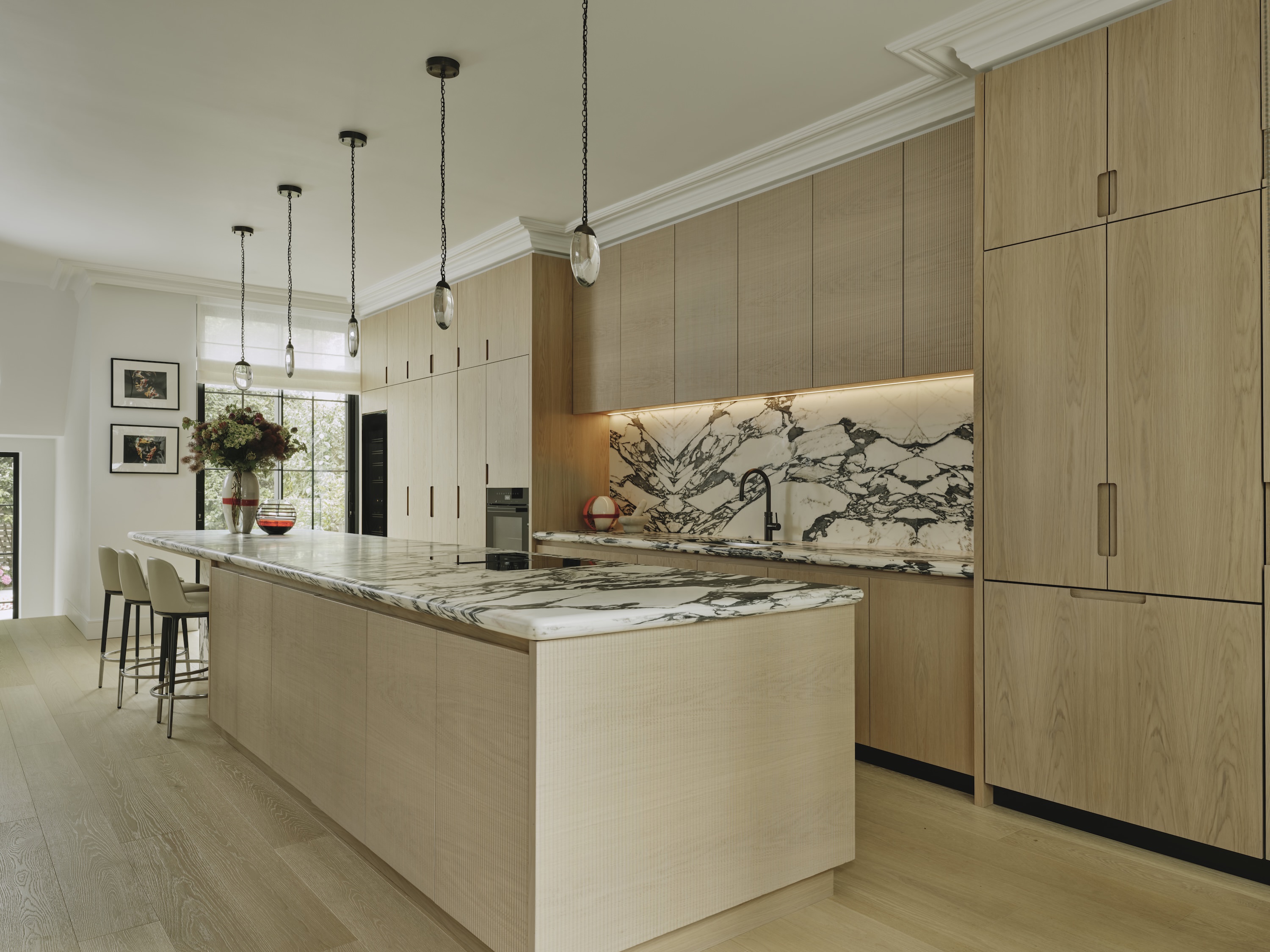
For Ledbury Studio founder Charlie Smallbone, the brief also arrived with its material already chosen. The clients had fallen in love with Arabescato Nero marble and it became the starting point for the whole design.
A clear brief
It’s the reverse of how most kitchen briefs start. Instead of working from a floor plan outward, Charlie was working from one slab of stone inward: the layout, the storage and the material palette elsewhere in the room all had to be resolved around a single decision the clients had already made.
“Our clients came to us already in love with the stone,” says Charlie. “That’s not unusual and it’s no bad thing, it’s actually a gift. It sets the ambition for everything else. Once you’ve chosen a material like Arabescato Nero marble, there’s no hiding behind a neutral scheme. The rest of the kitchen has to be as considered as the stone is dramatic.”
The marble: a dramatic centrepiece
Charlie made the marble the dramatic centrepiece of the room, wrapping it around an imposing pedestal base beneath the breakfast bar for maximum impact. A fabricated bullnose edge was specially designed for the effect, and the marble was honed rather than polished, for a softer, more understated elegance.
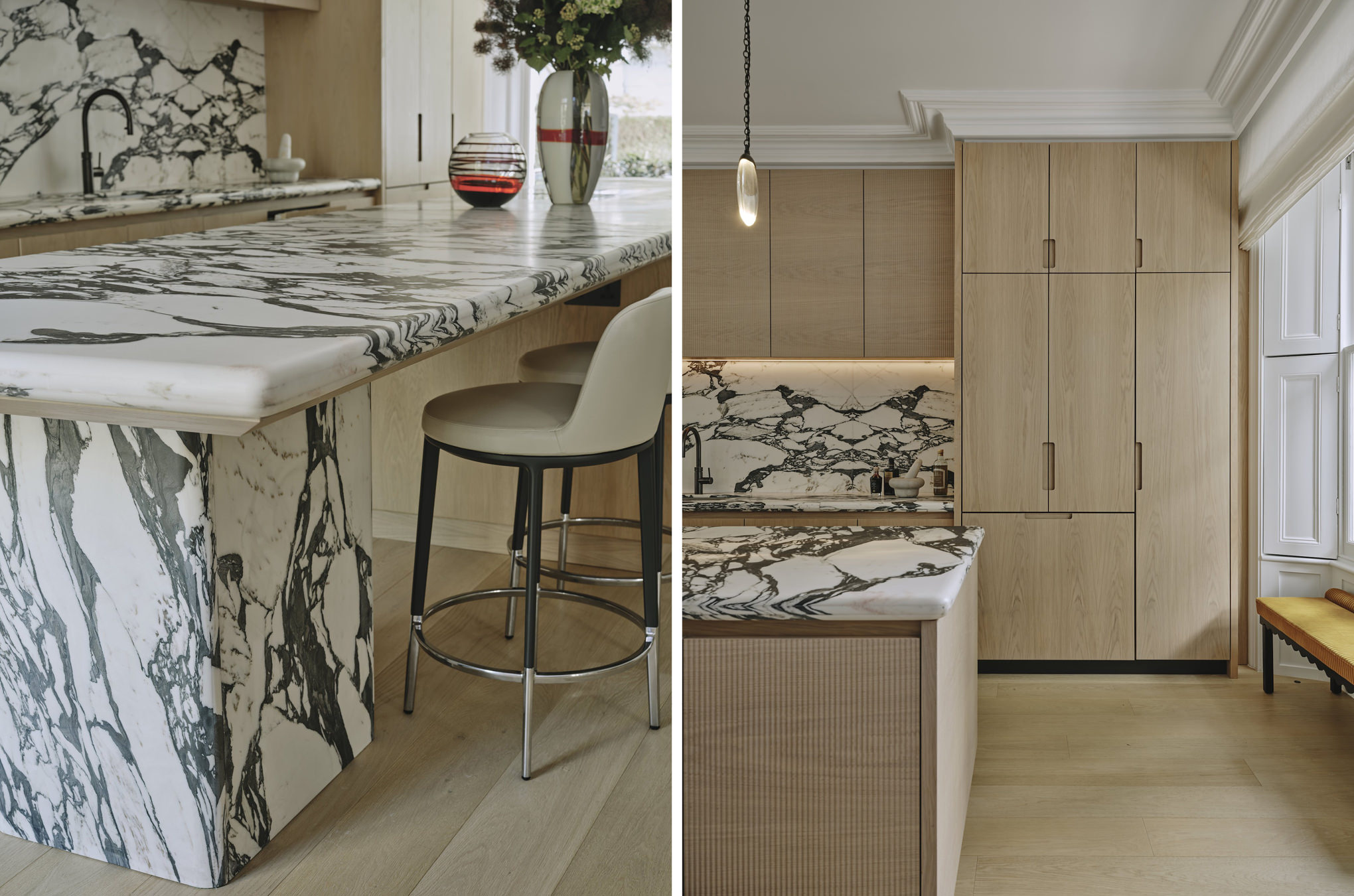
Book-matching, where two adjoining slabs of stone are cut and laid so their veining mirrors across the seam, has become one of the clearest signatures of a considered kitchen island. Rather than a run of stone broken up by a visible join, the effect reads as one continuous surface, and it’s increasingly the detail that separates a bespoke kitchen from an off-the-shelf one.
In the case of this kitchen, because the island sits on a suspended floor, its construction had to be carefully engineered to carry the weight of a 5.25-metre worktop, with two slabs of the marble book-matched at the centre for a seamless effect. It’s a structural question that comes up often in London’s period townhouses. Many have suspended timber floors, rather than a solid concrete slab, so for a large-format stone island the floor should be checked, and often reinforced, before the design can be finalised.
Oak, fluting and quiet storage
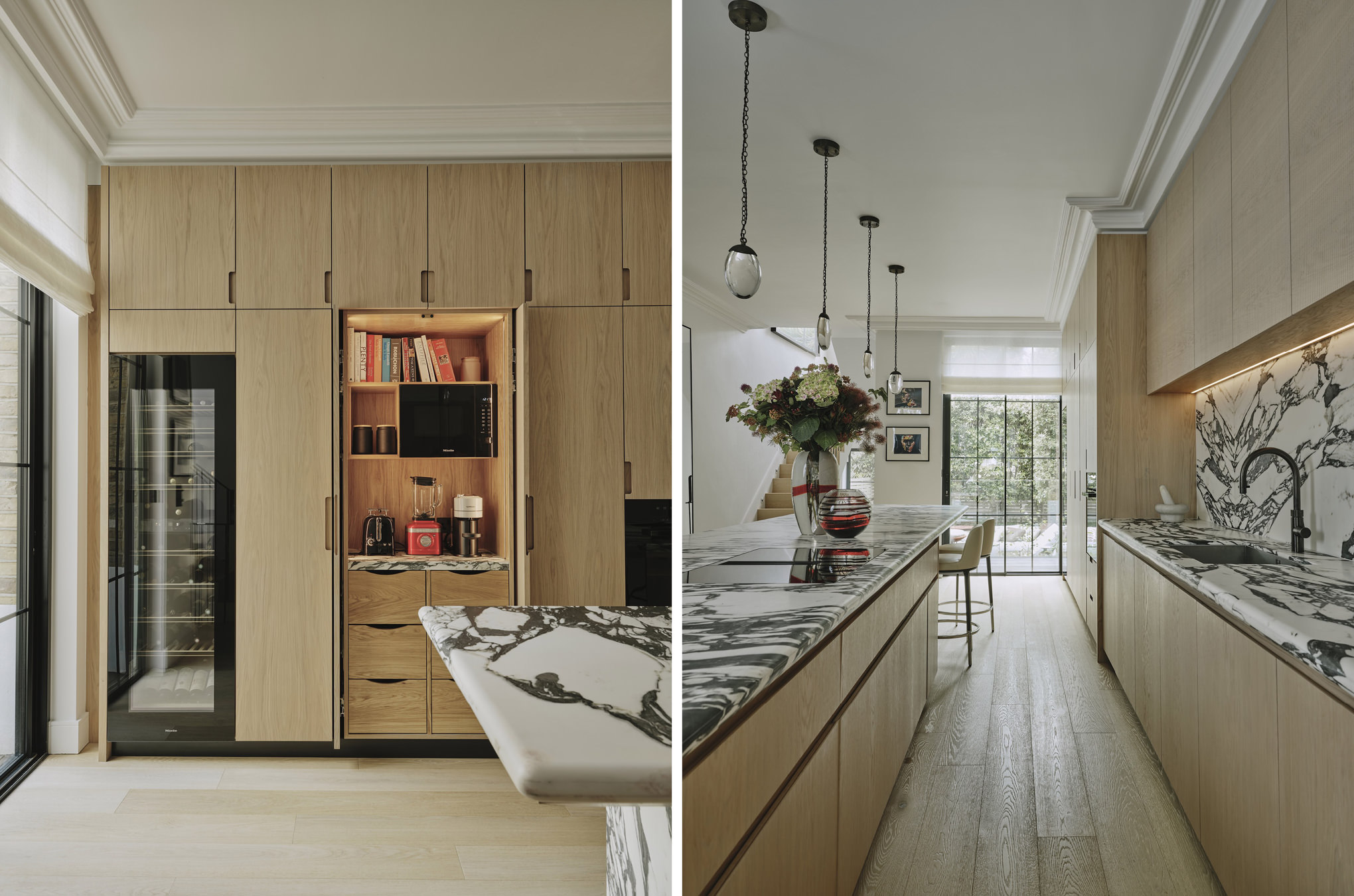
Charlie chose natural oak for the cupboards, which was given a light finish, rubbed back to expose the grain and finished with a pigmented pale wash. Handleless base cupboards and specially designed recessed handles on the tall cupboards keep the design minimal and contemporary, with the wine cooler and oven sitting flush within the run rather than sitting as separate elements.
In addition, the wall cupboards and room-facing island cupboard doors were given shallow fluting, with the timber grain fluted horizontally rather than vertically, for a softer, textured finish. Pairing a warm, pale oak with a cool, heavily veined marble is one of the more enduring material conversations in kitchen design: the wood softens the drama of the stone, while the marble stops the joinery from reading as flat.
The final word
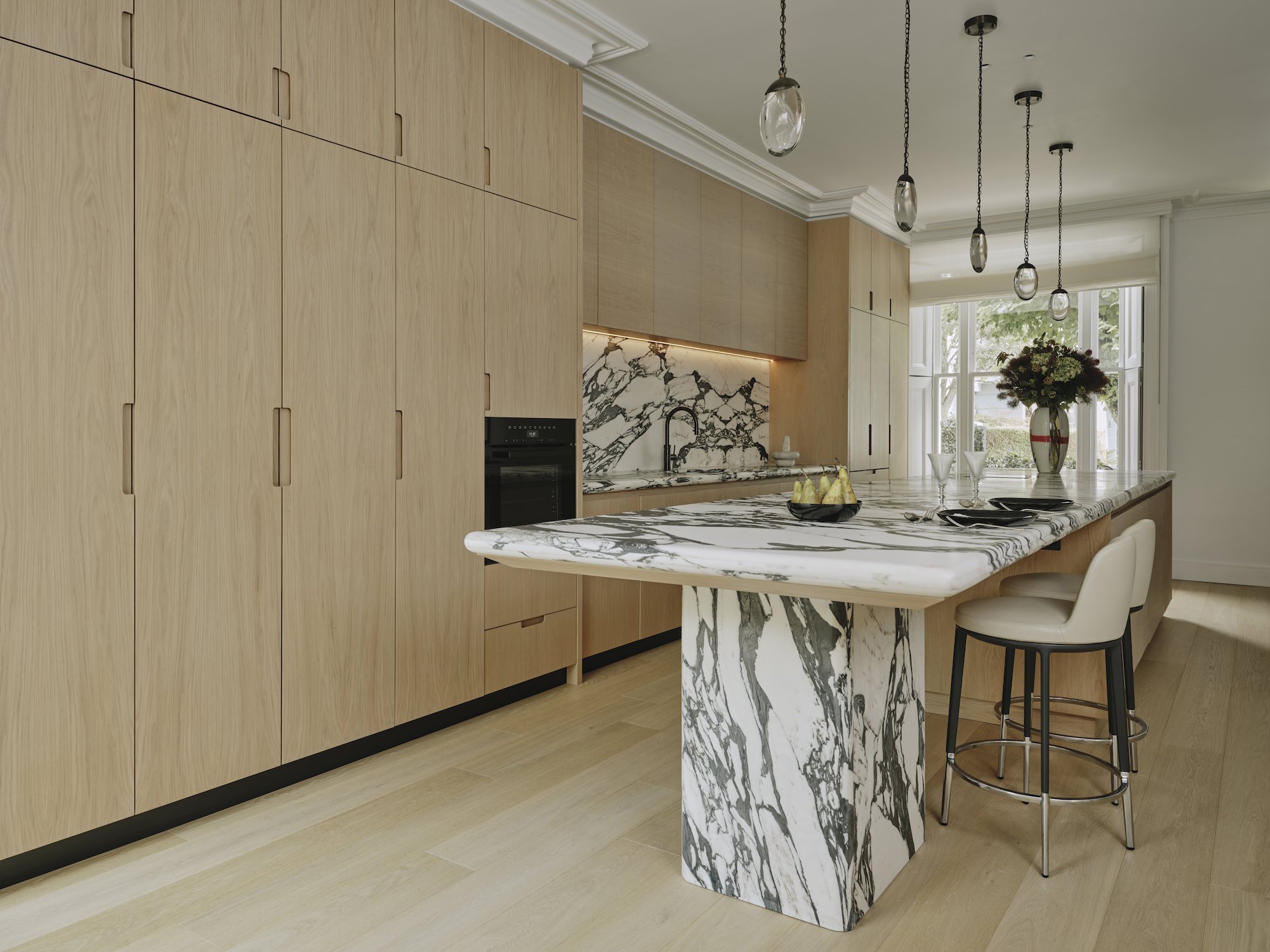
“A kitchen this striking still has to work every single day,” concludes Charlie. “The marble is what you notice first. But it’s the storage, the fluting and the way the oak sits against the stone that make you want to live in it.”
The result is a kitchen that is chic and understated, brought to life with the sophistication and drama that mark out a Ledbury Studio design. It’s a useful example of how a single material decision, made early and followed through with conviction, can shape everything else in a room: the cabinetry finish, the storage strategy, even the lighting, all worked out in relation to one slab of stone rather than added on top of it afterwards.
We use cookies on our website to give you the most relevant experience by remembering your preferences and previous visits.
By clicking "Accept All", you consent to the use of all such cookies. However, you can also select “Choose preferences” to provide a controlled consent.
© Ledbury Studio 2026.
